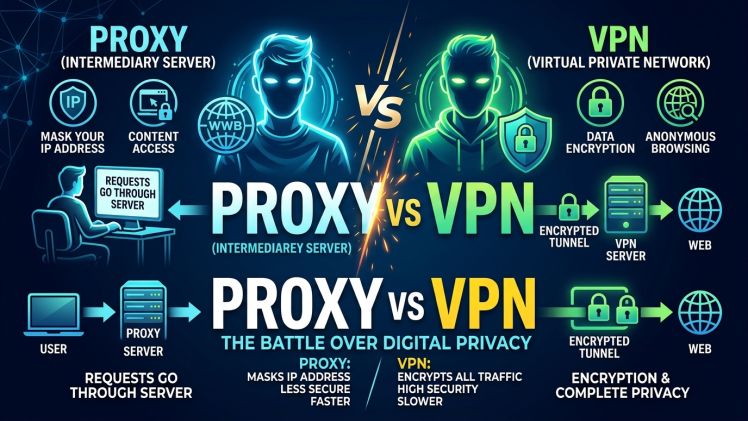
As businesses shift to remote work and users increasingly encounter regional restrictions and online risks, interest in tools that control digital identity is surging. Services like Buy Proxy offer flexible proxy solutions, enabling companies and individual users to quickly configure levels of anonymity and traffic routing. While VPNs remain the corporate standard, proxies—accessible through platforms like Buy Proxy—are regaining a competitive edge thanks to speed, configurability, and the ability to select specific proxy types for distinct user needs.
At first glance, the choice between the two may seem straightforward. VPNs create an encrypted tunnel between the user and the network, while proxies act as controlled routing points, masking IP addresses, filtering content, or hiding a user’s location. In practice, this results in differing levels of security, speed, and anonymity, depending on the model selected.
Proxy Servers: Flexibility and Control at the Core
Proxies act as intermediaries between users and the internet, redirecting requests, masking IPs, and sometimes encrypting traffic. Platforms like Private Buy Proxy allow users to select proxy type, region, and anonymity level for a wide range of purposes—from corporate access control to private browsing.
Forward Proxy
Used by companies needing a single point of network entry. It simplifies administration and protects internal IP addresses but is limited in scalability.
Transparent Proxy
Operates invisibly to the user, sometimes without their awareness. Convenient, but increases vulnerability to attacks such as SYN floods.
Anonymous Proxy
Does not reveal personal user data. Ideal for those seeking maximum privacy, and Buy Proxy provides a wide selection of anonymous proxies for these scenarios.
Distorting Proxy
Intentionally alters the IP address to simulate a different location. Useful for accessing region-restricted content, though some sites may block such connections.
Data Center Proxy
Hosted in real data centers, offering fast response times and cost efficiency. Perfect for rapid data collection, though less anonymous than other proxy types.
Public and Shared Proxies: Affordable but Limited
Public proxies are attractive due to low cost but suffer from slow speeds and potential security risks due to high user volume.
Shared proxies operate similarly but carry additional risk: multiple users share the same IP address, which can lead to bans even if you did nothing wrong.
SSL Proxy: The Gold Standard in Proxy Security
SSL proxies encrypt traffic between the server and client in both directions, offering a high level of protection. They are particularly useful for companies handling sensitive data. One limitation is the inability to cache encrypted content, which may reduce repeat-visit performance. Platforms like Private Buy Proxy provide SSL proxies with customizable speed and regional options.
VPN: Security Built Around Encrypted Tunnels
VPNs encrypt all traffic, making them essential for users operating in public networks or accessing corporate resources. Compared to proxies, VPNs are closed systems focused on security rather than flexibility.
Corporate VPN
Advantages include:
- fully encrypted channels for files and data,
- cost-effectiveness,
- improved remote collaboration.
Drawbacks: higher latency, limited flexibility, and less privacy than some users expect.
Personal VPN
Designed to hide location, secure public Wi-Fi access, and bypass regional restrictions. For many users, a VPN is the primary tool to safeguard daily online activity.
Proxy vs VPN: Function vs Philosophy
VPNs are optimized for environments where encryption and channel integrity are paramount. Proxies, in contrast, excel where speed, content filtering, IP variability, regional flexibility, and routing control are essential. With platforms like Buy Proxy, users can access fast, affordable solutions for everything from anonymous browsing to large-scale data collection.
In short, if the priority is secure corporate access or public network protection, VPNs are the logical choice. If speed, flexibility, adjustable anonymity, and task-specific routing matter most, proxies remain the more practical and versatile solution.